
Last updated September 10, 2026
Full 25-point door and opener safety check with every visit - springs, cables, rollers, tracks, and your LiftMaster or Chamberlain opener included
You get a price before we start. It does not change when the truck arrives.
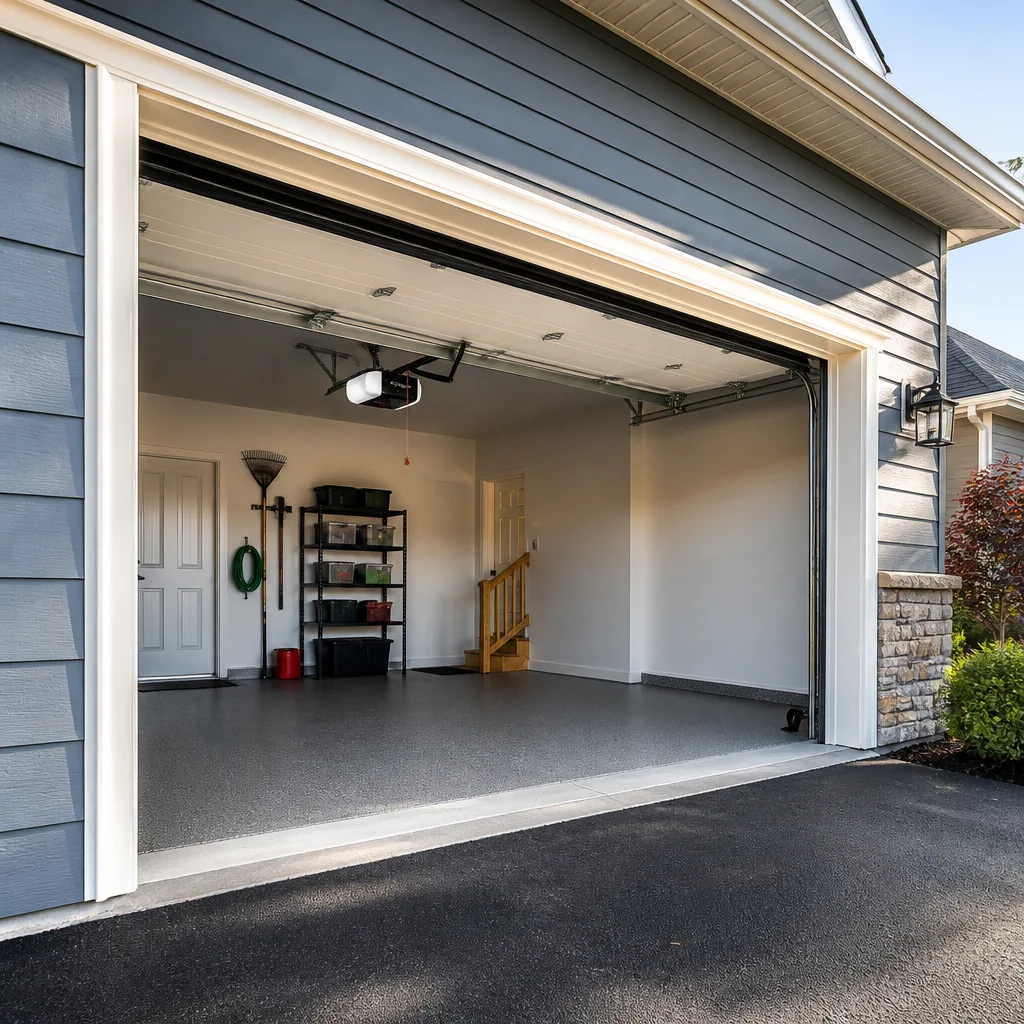
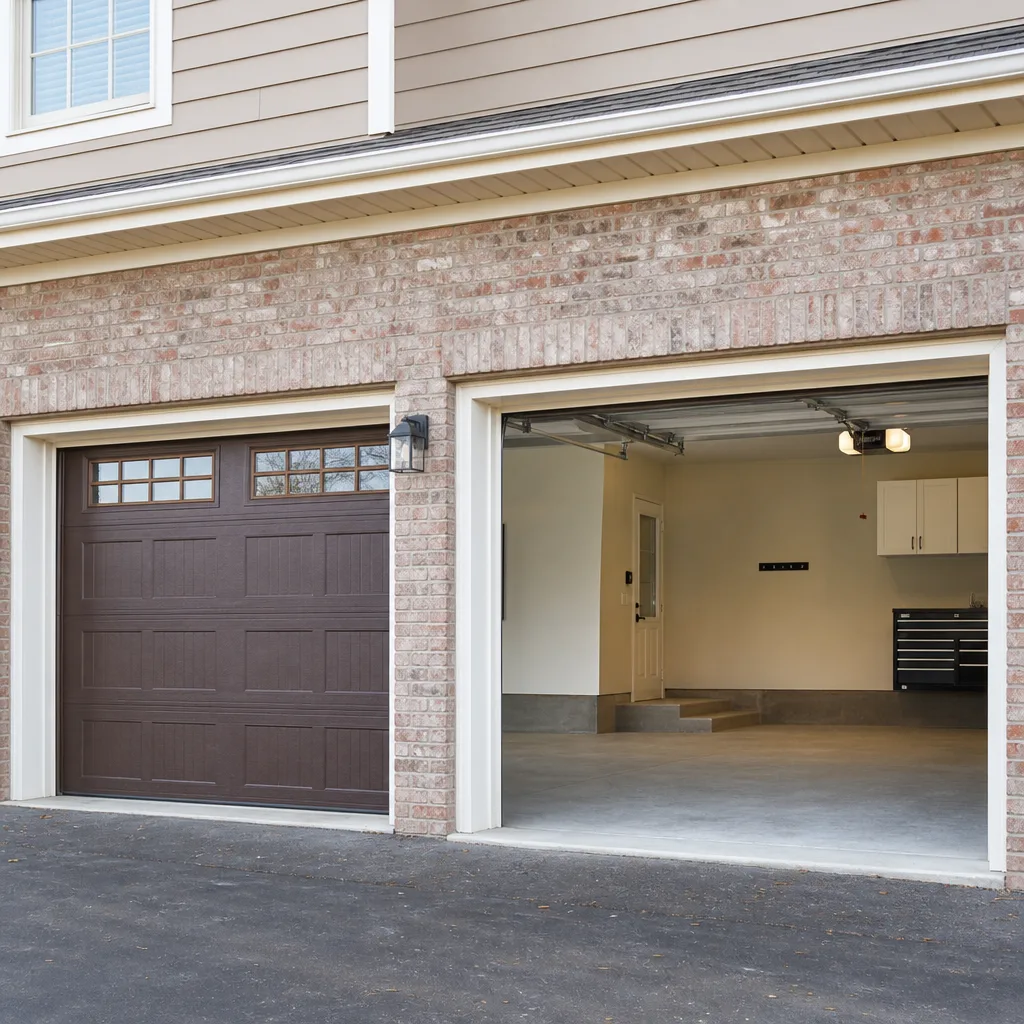
 Before
 After
After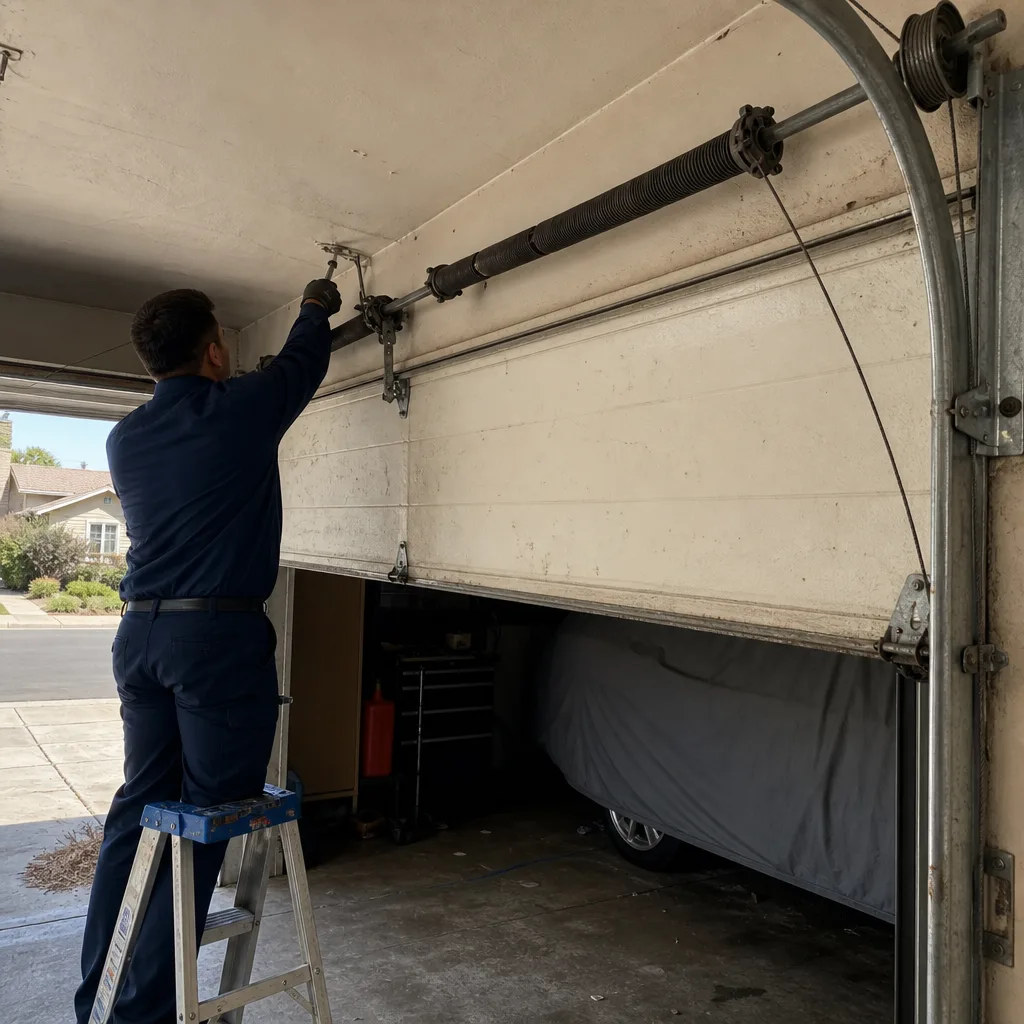 Before
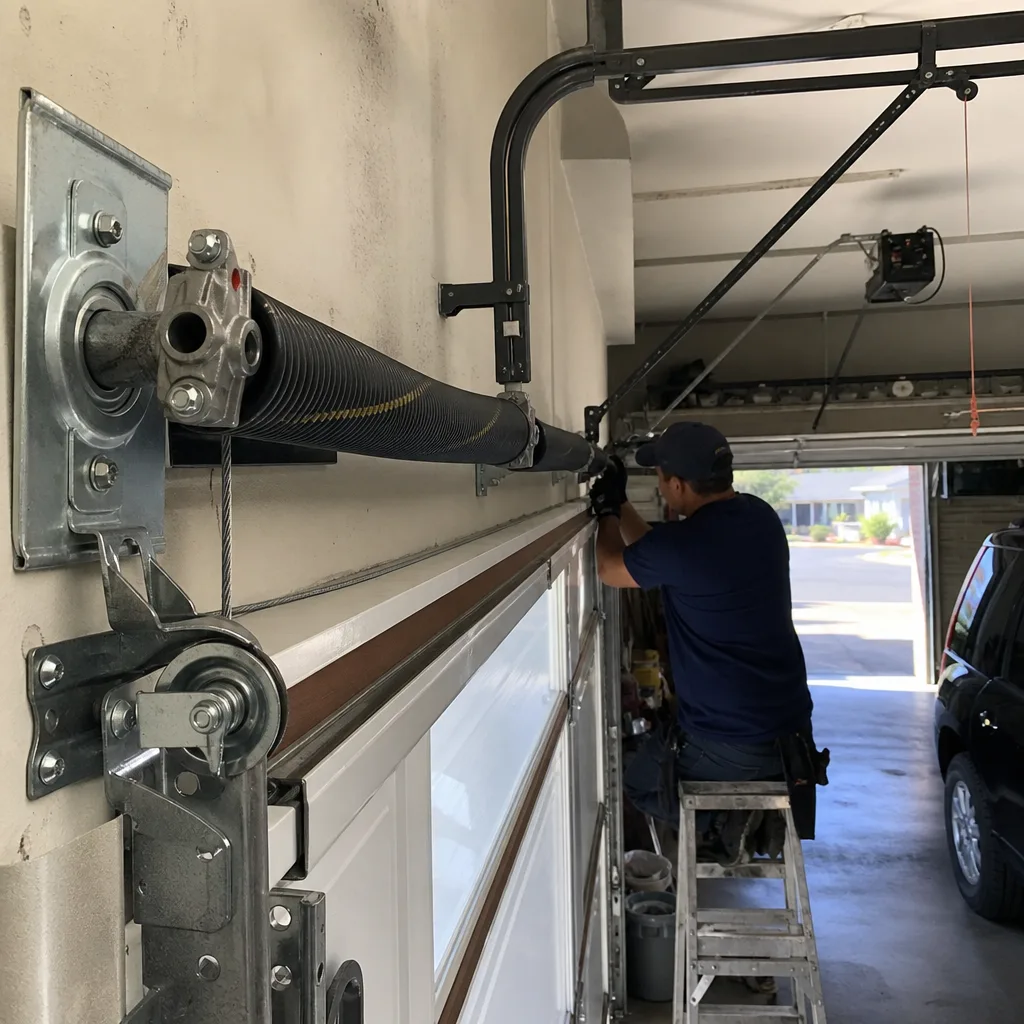 After
After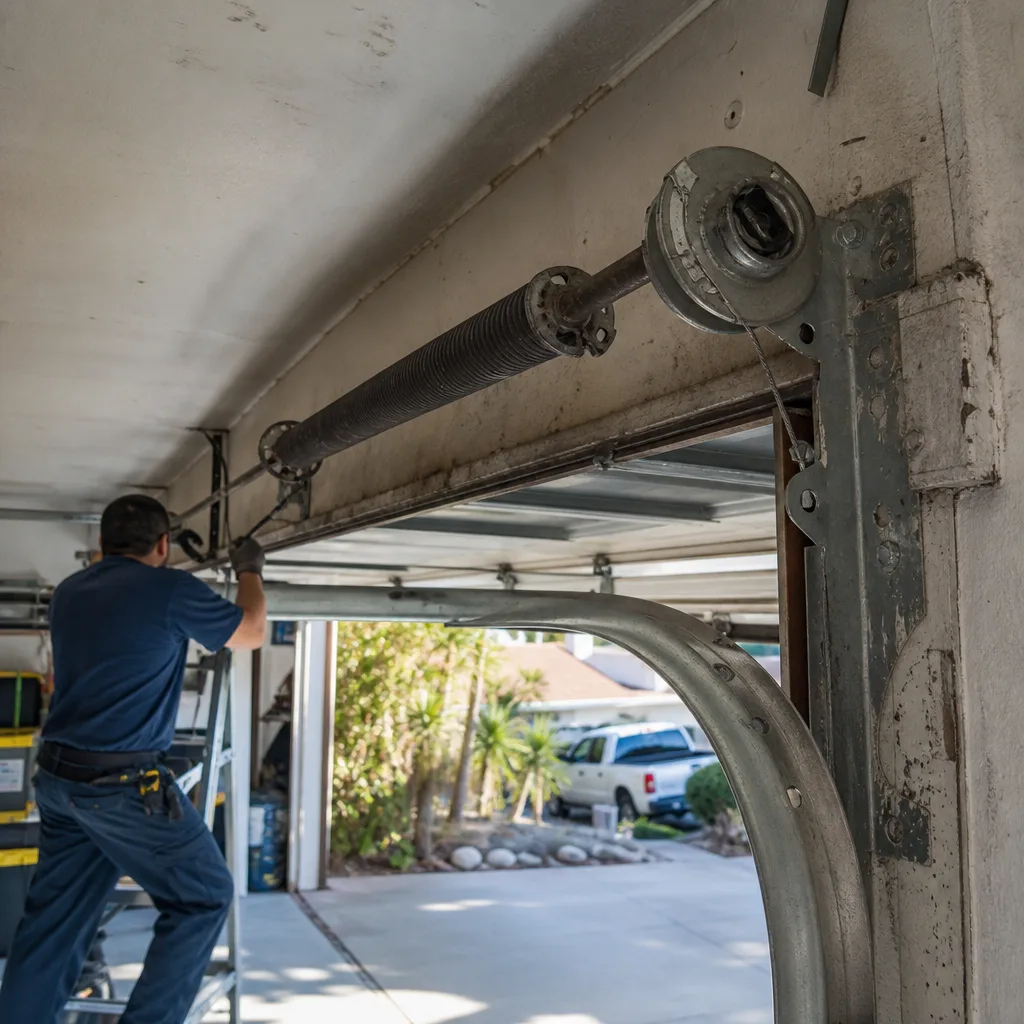 Before
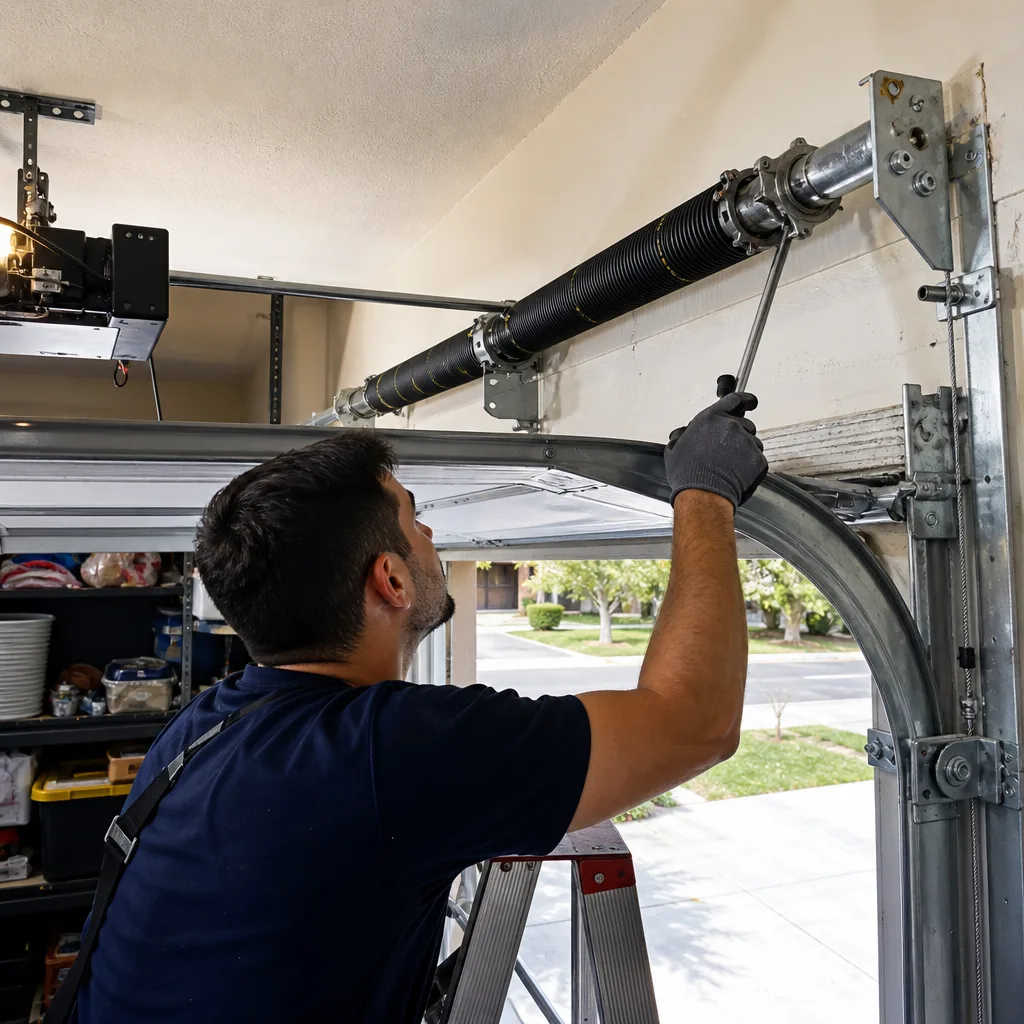 After
AfterDIY vs Professional Garage Door: The Santee Homeowner’s Decision Guide
Torsion spring replacement sends roughly 1,400 people to emergency rooms in the U.S. each year. The spring itself costs $35 at the hardware store. For Santee homeowners, the calculus isn’t about money - it’s about which garage door tasks reward your effort and which ones punish it. This guide gives you an honest split: what you can safely handle with basic tools, what requires specialized equipment and training, and how to know the difference before you’re committed. We’ll cover actual dollar savings on safe DIY work, the real risk profile of dangerous repairs, California warranty implications, and how one professional visit can set you up for years of confident maintenance.
Quick Answer
Most Santee homeowners can safely handle lubrication, sensor cleaning, limit switch adjustment, and bottom seal replacement. Torsion spring replacement, cable drum work, and structural track repairs should be left to trained technicians with the right tools and insurance. The dividing line is not skill - it’s stored kinetic energy and the potential for serious injury.
Table of Contents
- The Real Cost of DIY Garage Door Repair
- DIY-Safe Tasks: What Santee Homeowners Can Handle
- The Danger Zone: Never DIY These Repairs
- Tools You Need vs. Tools That Warn You to Stop
- California Warranty and Liability: What Changes When You DIY
- Using a Pro as Your Calibration Point
- Santee’s Climate and What It Does to Garage Doors
- Cost Comparison: DIY Savings vs. Pro Value
The Real Cost of DIY Garage Door Repair
Homeowners in Santee often start with a simple question: how much can I save by doing this myself? The honest answer depends entirely on which part of the system you’re touching.
A garage door is the largest moving object in most homes. It weighs between 150 and 400 pounds, depending on material and size, and it’s balanced by components under extreme tension. The cost of DIY is not just the part you buy. It’s the tool you don’t own, the adjustment you get slightly wrong, the warranty you void, and the injury you didn’t anticipate.
We’ve been serving Santee since 2016, and in our experience, the homeowners who come out ahead are the ones who know their own line. They handle the routine maintenance that prevents problems, and they call us for the work that involves stored energy or structural load.
Here’s how the math actually breaks down for common scenarios:
| Task | DIY Part Cost | Professional Repair in Santee | Your Real Savings |
|---|---|---|---|
| Annual lubrication and inspection | $15-$25 | $89 (Seasonal Tune-Up) | $64-$74 if done correctly |
| Safety sensor realignment | $0 | $85-$150 | $85-$150 |
| Bottom seal replacement | $20-$40 | $150-$250 | $110-$210 |
| Remote programming | $0 | $75-$125 | $75-$125 |
| Torsion spring replacement (single) | $35-$60 | $180-$340 | Not applicable - injury risk |
| Cable drum repair | $25-$45 | $200-$380 | Not applicable - injury risk |
| Track replacement or realignment | $50-$120 | $250-$500 | Not applicable - structural risk |
The pattern is clear. The safe DIY tasks save $75-$210 and carry minimal downside. The dangerous tasks “save” $140-$380 on paper, but that savings evaporates with one ER visit, one failed warranty claim, or one door that comes off the track and damages your vehicle.
In Santee’s competitive housing market, a garage door that doesn’t operate smoothly also affects curb appeal and resale value. A door that sticks, shudders, or reverses unpredictably is a red flag to buyers and inspectors. The money you “save” on a botched DIY repair often returns as a deduction at closing.
DIY-Safe Tasks: What Santee Homeowners Can Handle
These four categories of work are genuinely within reach of a careful homeowner with basic tools. They involve no stored tension, no heavy lifting, and no structural modification.
1. Lubrication and Visual Inspection
This is the foundation of garage door longevity. In Santee’s dry, warm climate, dust and heat accelerate wear on moving parts. A twice-yearly lubrication takes 20 minutes and prevents most common problems.
- Close the door and disconnect the opener by pulling the red emergency release cord.
- Apply silicone-based spray lubricant to the hinges, rollers, and bearing plates. Do not use WD-40 - it attracts dust and gums up in heat.
- Lightly coat the torsion spring with lubricant. Do not touch the spring; spray from 6 inches away.
- Inspect cables for fraying, rollers for wobble, and hinges for cracks.
- Reconnect the opener and test the door for smooth, quiet operation.
If you find frayed cables or a cracked spring during inspection, stop. That is not a maintenance task. Call a professional.
2. Safety Sensor Cleaning and Realignment
Photo-eye sensors sit 4-6 inches off the ground on both sides of the door. When they’re dirty or misaligned, the door reverses randomly or refuses to close.
- Wipe both sensor lenses with a soft cloth.
- Check that both sensors’ LED lights are solid (not blinking).
- Loosen the wing nut on the blinking sensor, adjust until the light steadies, then retighten.
- Test by closing the door and waving an object through the beam - it should reverse.
This is a zero-cost fix that solves maybe 30% of the “my door won’t close” calls we get in Santee.
3. Limit Switch Adjustment
If your door doesn’t fully open or closes then reverses, the opener’s limit switches may need calibration. This is a screwdriver adjustment on the opener unit, not the door itself.
- Locate the limit adjustment screws on the opener motor housing - usually marked “up” and “down.”
- Turn the appropriate screw 1/4 turn at a time.
- Test after each adjustment.
Consult your opener manual for the specific location. Chamberlain and Genie units have slightly different layouts, but the principle is identical.
4. Bottom Seal Replacement
The rubber seal along the door bottom hardens and cracks in Santee’s sun exposure. Replacement is straightforward on most modern doors.
- Remove the old seal by pulling it from the retainer channel.
- Clean the channel of debris.
- Lubricate the new seal with dish soap and slide it into place.
- Trim excess with a utility knife.
Older Clopay or Amarr doors may use a proprietary seal profile. If the new seal won’t seat, the channel may be damaged or non-standard. That’s your signal to call for a garage door repair in Santee rather than forcing it.
The Danger Zone: Never DIY These Repairs
Some garage door components are not designed for amateur handling. The danger is not hypothetical. We have seen the aftermath.
Torsion Springs
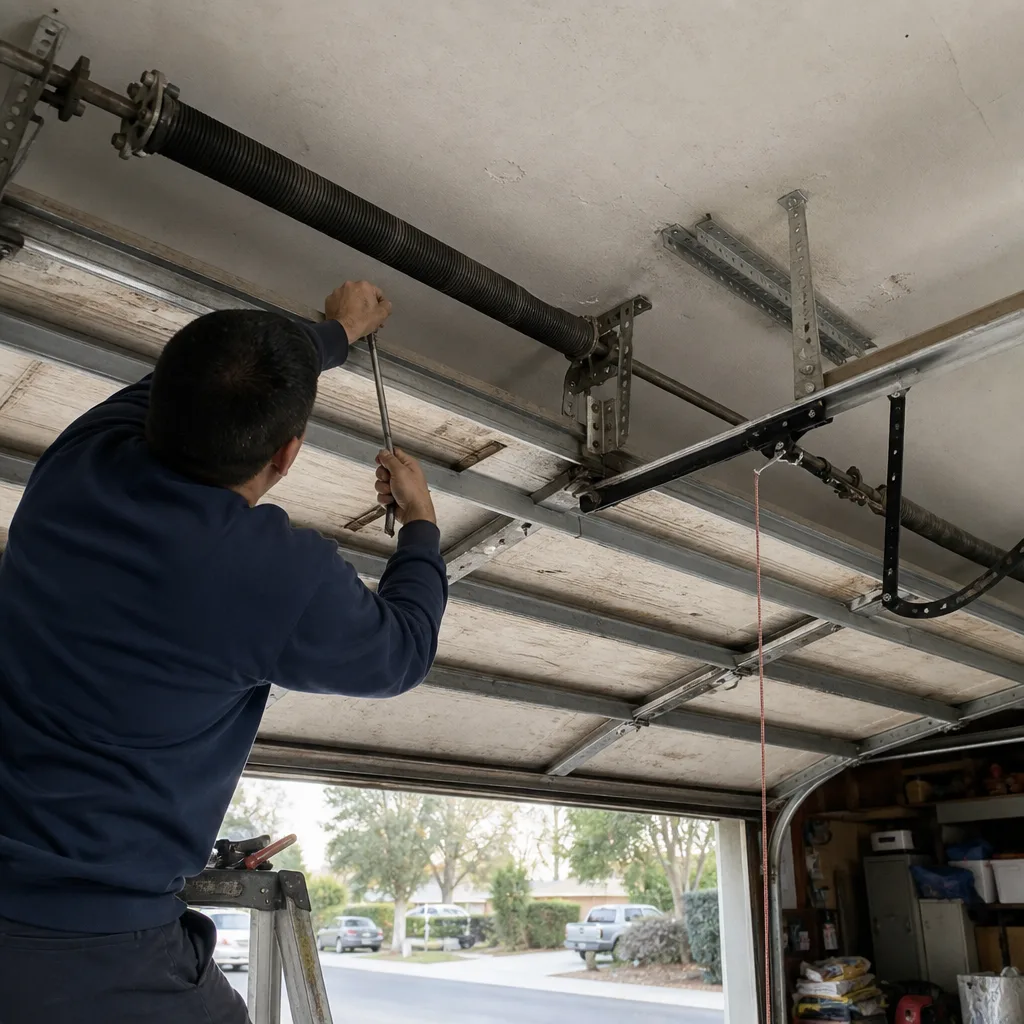
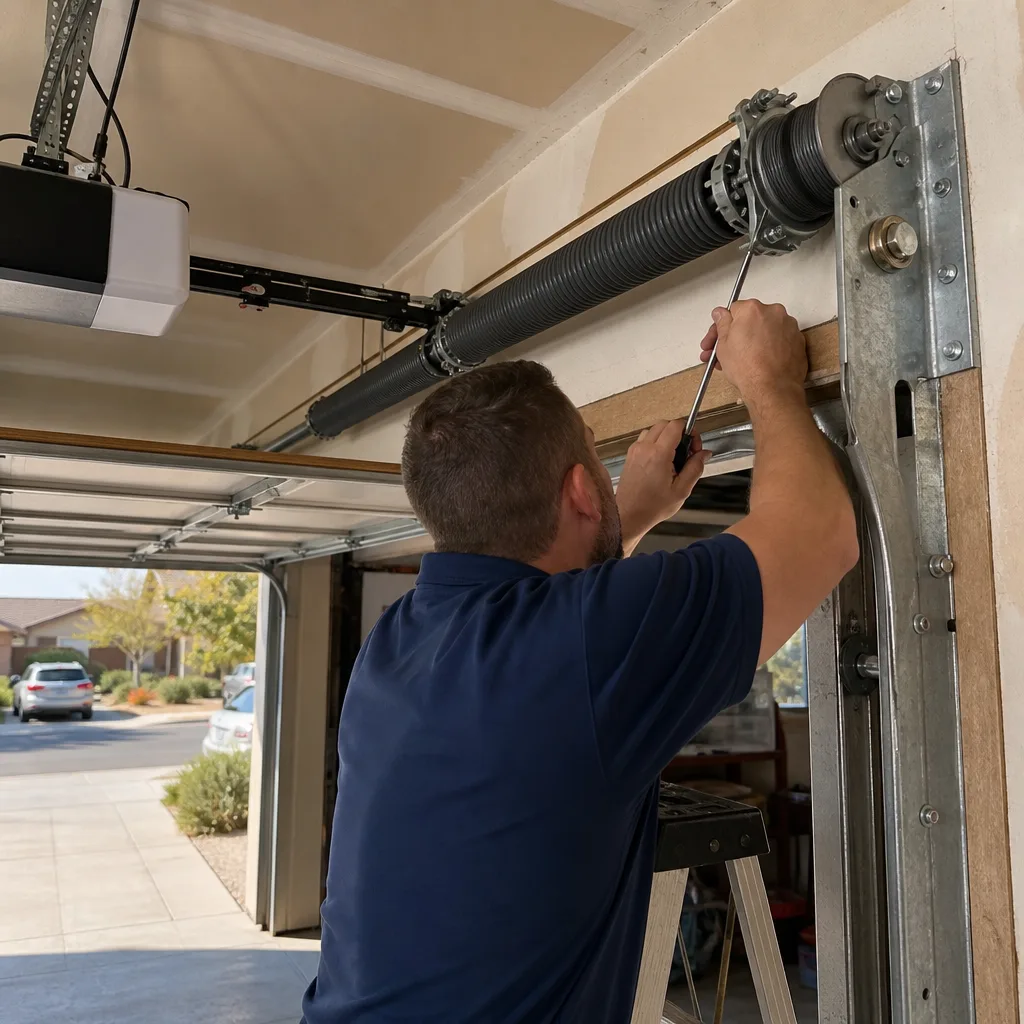
A torsion spring is a steel coil wound tight enough to counterbalance 150-400 pounds of door weight. It stores enough kinetic energy to lift that weight thousands of times. When it breaks, it sounds like a gunshot. When an untrained person tries to wind or unwind it, the winding bar can slip, and the spring releases with lethal force.
The 1,400 annual ER visits are not from careless people. They’re from competent homeowners who watched a video, bought the right part, and made one small error in technique. The $35 spring savings is not worth a broken hand, facial fracture, or worse.
In Santee, we regularly see spring failures accelerated by heat cycling - the temperature swing from 55°F mornings to 85°F afternoons stresses the steel. If your spring is 7-10 years old, it’s living on borrowed time. Have it inspected by a technician who can replace it safely and balance the door correctly.
Cable Drums and Lift Cables
Cables run from the bottom brackets to the cable drums at each end of the torsion shaft. They are under constant tension, even when the door appears still. A frayed cable can snap without warning. A drum that has slipped off its grooves can release tension asymmetrically, causing the door to drop or twist.
Working on cables requires releasing spring tension first - which brings you back to the torsion spring problem. There is no safe shortcut.
Structural Track Replacement
The vertical and horizontal tracks guide the door and bear its weight during travel. If a track is bent, corroded, or pulling away from the wall, the door’s weight distribution changes. Removing a track section without supporting the door properly can cause collapse.
Santee’s occasional Santa Ana wind events and minor seismic activity can loosen track mounting over time. If you see gaps between the track and wall, or if the door binds at a specific point, the mounting may need reinforcement. This is not a homeowner job.
Opener Motor and Drive Assembly Internal Repairs
While sensor adjustment and limit switch tuning are safe, opening the motor housing to repair gears, capacitors, or circuit boards exposes high-voltage components. It also voids warranty coverage on most Chamberlain, Genie, and other major brands. For opener issues beyond basic settings, a garage door opener in Santee specialist is the right call.
Tools You Need vs. Tools That Warn You to Stop
The tools required for safe DIY maintenance are common. The tools required for dangerous repairs are specialized and expensive. The absence of the right tool is itself a signal.
Tools for Safe DIY Work
- Silicone-based spray lubricant (not WD-40)
- Soft cloths and mild cleaner
- Phillips and flat-head screwdrivers
- Adjustable wrench
- Level
- Stepladder (for sensor and opener access)
- Utility knife
Total investment: under $50 if you don’t already own them.
Tools That Signal “Call a Professional”
If you find yourself needing any of the following, you have crossed from maintenance into repair territory:
- Winding bars (solid steel bars inserted into the cogs of a torsion spring system)
- Vise-grip pliers rated for spring work
- Cable pullers or come-alongs
- Torque measuring devices
- Spring calibration charts
Winding bars are the clearest boundary. They are not improvised tools. A screwdriver, bolt, or piece of rebar will not substitute. If you need winding bars, you need a technician who owns them and has been trained to use them under load.
At Mainspring Garage Door Co., our trucks carry every specialized tool for spring, cable, and track work. Most repairs in Santee are completed in a single visit because the equipment travels with us. The homeowner who tries to match that tool inventory for a one-time repair spends more on equipment than the professional service would cost.
California Warranty and Liability: What Changes When You DIY
California’s consumer protection laws are strong, but they have limits. Manufacturer warranties on garage door components typically require installation by an authorized dealer or licensed technician. When you perform certain repairs yourself, you may forfeit that protection.
What the Warranty Actually Says
Read the fine print on your Clopay, Amarr, or other brand warranty. Most state that “damage resulting from improper installation, alteration, or repair by unauthorized persons” is excluded. This is not boilerplate. Manufacturers enforce it.
A homeowner who replaces their own torsion spring and later experiences panel damage from an unbalanced door has no warranty claim. The manufacturer will point to the self-performed spring work as the voiding event. The $180-$340 professional spring replacement, in retrospect, was the cheaper option.
Homeowner’s Insurance Considerations
If a DIY repair leads to property damage or injury to a third party, your homeowner’s policy may not cover the loss. Most policies exclude damage from work performed without proper licensing or permits. A door that comes off its track and damages your vehicle, or injures a visitor, creates a coverage dispute that you do not need.
Professional garage door companies carry general liability and workers’ compensation insurance. If something goes wrong during our work, our policy responds. You are not exposed.
California Contractor Law
Garage door installation and structural repair fall under CSLB licensing requirements. While routine maintenance does not require a license, any work that modifies the structural system or involves load-bearing components technically does. A homeowner performing their own torsion spring replacement is not in violation of contractor law - they are simply uninsured and unprotected if the work fails.
Using a Pro as Your Calibration Point
The smartest approach to garage door care is not all-DIY or all-pro. It’s using a professional visit to establish a baseline, then maintaining from that foundation with confidence.
The One-Time Calibration Visit
A trained technician can assess your entire system in 30 minutes and identify issues you would not notice. Spring fatigue measured in turns remaining. Cable wear invisible to casual inspection. Track alignment checked with precision tools. Opener force settings tested against current safety standards.
After this visit, you know exactly what condition your door is in. You know which components are aging and which are sound. You have a written report with specific measurements, not a vague “everything looks fine.”
From that baseline, your twice-yearly lubrication and inspection has purpose. You’re not guessing whether a noise is normal - you’re comparing to a known good state. You’re not wondering if the spring is due - you know it has 18 months of cycles remaining, and you’ve scheduled replacement before failure.
What This Costs and What It Saves
Our $89 Seasonal Tune-Up includes full inspection, lubrication, safety test, and written condition report. For Santee homeowners, this is often the only professional visit needed in a given year. The rest is maintenance you handle yourself, informed by professional knowledge.
This model saves money over reactive repair. A spring replaced on schedule, before it breaks, doesn’t damage cables or panels. A sensor cleaned quarterly doesn’t fail and strand you with a door that won’t close. The calibration visit turns garage door care from mystery into routine.
Carl Dutton has built this approach into Mainspring’s service model. We’re not interested in selling you repairs you don’t need. We’re interested in a relationship where you know your door, we know you, and problems get caught early.
Santee’s Climate and What It Does to Garage Doors
Santee’s location in San Diego’s inland valley creates specific conditions that affect garage door longevity and maintenance needs. Understanding these local factors helps homeowners make better DIY vs. pro decisions.
Heat and UV Exposure
Summer temperatures in Santee regularly reach the high 80s and low 90s. Direct sun on a south-facing garage door can push surface temperatures past 140°F. This hardens rubber seals, degrades plastic opener components, and accelerates spring metal fatigue.
Bottom seals on sun-exposed doors may need replacement every 2-3 years rather than the 4-5 typical in cooler coastal areas. This is a safe DIY task, as described above, but it comes up more frequently here.
Dust and Santa Ana Winds
Santee’s dry climate and periodic Santa Ana wind events blow fine dust into track systems and onto sensor lenses. Doors in neighborhoods near Mission Trails or the eastern edge of town see more particulate accumulation. Quarterly sensor cleaning and track wiping prevents the false reverses and binding that lead to service calls.
Minor Seismic Activity
California’s ongoing minor earthquakes gradually loosen track mounting and hardware. In Santee, we inspect mounting bolts as part of every service call. A homeowner doing their own visual inspection should check for wall gaps or bolt looseness - but tightening structural fasteners is only safe if you know the original torque specification. When in doubt, this is a pro task.
Neighborhood-Specific Notes
In older Santee neighborhoods like those near Carlton Hills or the original riverbed development, garage doors from the 1970s and 1980s may have non-standard track systems or obsolete spring configurations. DIY parts from big-box stores often don’t fit. These doors benefit enormously from a professional assessment before any work begins.
Newer developments around Fanita Ranch or Mast Park have standard modern systems that are more DIY-friendly for maintenance - but the same danger-zone rules apply for repairs.
Cost Comparison: DIY Savings vs. Pro Value
Let’s put real Santee numbers on the decisions homeowners face. These ranges reflect our actual pricing and typical part costs in the local market.
| Scenario | DIY Approach | Professional Service | 5-Year Outcome |
|---|---|---|---|
| Annual maintenance only | $30/year in supplies, 4 hours labor | $89/year Seasonal Tune-Up | Pro route catches problems early; DIY saves $295 but risks missed wear |
| Sensor cleaning (recurring issue) | $0, 10 minutes quarterly | $85-$150 per service call | DIY wins decisively - zero risk, clear savings |
| Spring replacement (one failure) | $50 parts, $200+ tools, injury risk | $180-$340, warranted, insured | Pro route includes balance check and hardware inspection; DIY risks cascade damage |
| Full door replacement | Not feasible - requires 2+ people, specialized tools, disposal | $1,200-$3,500 depending on size and material | Professional installation in Santee includes haul-away, warranty, and proper sizing |
| Opener replacement | $150-$400 for unit, self-install possible on basic models | $300-$600 installed and programmed | Pro route ensures force settings match door weight; DIY install often leads to callback for adjustment |
The pattern across these scenarios is consistent. Maintenance favors DIY. Repair favors professional service. Replacement is almost always professional work due to scale, warranty, and safety requirements.
For Santee homeowners in the 55-75 age range who plan to stay in their homes, the professional route also removes physical strain. A 16-foot steel door panel weighs over 100 pounds. Even “assisted” DIY installation involves lifting and maneuvering that load. Our technicians handle this daily with proper equipment and technique.
Common Mistakes to Avoid
- Using WD-40 as garage door lubricant. It’s a solvent, not a lubricant, and it attracts dust that grinds down moving parts in Santee’s dry climate. Use silicone-based spray only.
- Ignoring a single loud pop from the garage. That sound is a torsion spring breaking. Do not attempt to open the door manually - the opener will strain, cables may slip, and the door can drop. Call for service immediately.
- Adjusting torsion springs with makeshift tools. We have seen homeowners use screwdrivers, ratchet handles, and even tire irons as winding bars. Each one is an ER visit waiting to happen. There is no safe improvisation here.
- Replacing one spring when two are installed. Dual-spring systems are balanced as a pair. A new spring paired with a fatigued old spring creates uneven lift, premature wear, and door binding. Always replace springs in matched sets.
- Skipping the safety reverse test after any adjustment. Federal law requires automatic reversal on contact. After any work on your door or opener, test the reverse function with a 2×4 laid flat. If the door doesn’t reverse on contact, the opener is unsafe.
- Assuming all brands use the same parts. Chamberlain openers and Genie openers have different rail designs, limit switch locations, and remote frequencies. Clopay and Amarr doors use different seal profiles and hinge patterns. Verify compatibility before ordering parts.
When to Call a Professional
Call a technician when the work involves stored tension, structural load, electrical internals, or any task where you cannot clearly answer “what happens if this goes wrong?” with “nothing serious.”
Specific triggers: a broken spring or cable, a door off its track, an opener that hums but doesn’t move the door, visible track damage or wall separation, or any repair attempt that hasn’t solved the problem in 30 minutes of careful work.
Mainspring Garage Door Co. offers free estimates in Santee - call (619) 762-3668. We answer live, 24/7, including nights, weekends, and holidays. Our technician will assess your door, explain what we find, and state a flat price before any work begins. No surprises on the bill.
Frequently Asked Questions
Single torsion spring replacement in Santee typically runs $180-$340, including the spring, labor, balance adjustment, and safety inspection. Dual-spring systems run $280-$480. Call (619) 762-3668 for an exact quote - estimates are free.
Basic chain-drive openers can be self-installed by a handy homeowner with a helper, proper ladder, and 3-4 hours. Belt-drive and wall-mount units require more precise alignment and force calibration. For any opener, professional installation ensures the force settings match your door’s actual weight, which is critical for safety reverse function. We install and service all major brands including Chamberlain and Genie.
No. At Mainspring, the flat price is stated before any work begins. If we discover additional issues during inspection, we explain them and quote separately. You approve every dollar before we proceed. No surprises on the bill.
Yes. Our trucks are stocked with springs, cables, rollers, hinges, and openers from all major brands. Most repairs in Santee are completed in a single visit. If your door requires a special-order panel or custom color, we measure and schedule return installation - but this is rare.
For Santee’s climate, we recommend a professional inspection and tune-up annually, with homeowner-performed lubrication and visual inspection every six months. Annual professional service catches spring fatigue, cable wear, and track issues before they become emergencies. Our $89 Seasonal Tune-Up includes full inspection, lubrication, safety test, and written report.
It depends on the component and the repair. Manufacturer warranties on springs, panels, and openers typically exclude damage from “improper installation, alteration, or repair by unauthorized persons.” Routine maintenance like lubrication and sensor cleaning does not void warranty. Structural repairs, spring replacement, and opener internal work usually do. Check your specific warranty terms - or call us for a Free Second Opinion on any written estimate you’ve received.
The Bottom Line
The Santee homeowner who comes out ahead on garage door care knows this: lubrication, sensor cleaning, limit adjustment, and seal replacement are safe, genuine savings. Torsion springs, cables, tracks, and structural work carry consequences that erase any savings with one mistake. The right approach is not fear - it’s clarity about which side of that line you’re on. Use a professional for the dangerous work and the initial calibration. Handle the maintenance yourself from an informed baseline. And when you need a technician, choose one who states the price upfront, carries the parts on the truck, and stands behind the work in writing.
Call Mainspring Garage Door Co. at (619) 762-3668 for a free estimate. We’re here when you need us, with no phone trees and no surprises.
Written by Carl Dutton, Owner at Mainspring Garage Door Co., serving Santee since 2016.