
Last updated September 10, 2026
Full 25-point door and opener safety check with every visit - springs, cables, rollers, tracks, and your LiftMaster or Chamberlain opener included
You get a price before we start. It does not change when the truck arrives.
 Before
 After
After Before
 After
After Before
 After
AfterGarage Door Warning Signs: A Santee Homeowner’s Reference Guide
A torsion spring under tension holds roughly 300 pounds of stored energy. It doesn’t fail quietly, and it rarely fails at a convenient time. In Santee, where summer heat pushes into the 90s and winter mornings can dip below 40, that metal is cycling through expansion and contraction every single day. Most garage door failures announce themselves weeks or months before they strand a car in the driveway or send a door crashing down. The problem is that the language of a dying garage door - the sounds, the hesitations, the subtle shifts in how it moves - isn’t obvious to someone who hasn’t spent decades listening to it. This guide - along with The Complete Guide to Garage Door in Santee - translates those signals into plain terms, so you can decide whether to schedule a routine visit or stop using the door today.
Quick Answer
The most critical garage door warning signs are: a loud pop or bang from the spring assembly (indicates imminent spring failure), a door that won’t stay open at the halfway position (spring fatigue), grinding or squealing during operation (roller or opener gear wear), sagging or frayed cables (safety hazard requiring immediate professional attention), and a door that reverses before touching the floor (misaligned or failing safety sensors). If you notice any of these in your Santee home, hire a garage door contractor to inspect the door before the next use.
Table of Contents
- What Your Garage Door Is Trying to Tell You: A Sound-by-Sound Breakdown
- The Three-Minute Driveway Inspection Anyone Can Do
- Why a Slow-Closing Door Is a Safety Sensor Issue Until Proven Otherwise
- The Overnight Sag Test: Checking Spring Health Without Tools
- How to Categorize Urgency: This Week, This Weekend, or Stop Using It Now
- How Santee’s Climate Wears on Garage Doors Differently
- Opener Warning Signs That Mimic Door Problems
- Common Mistakes to Avoid
- When to Call a Professional
- Frequently Asked Questions
- The Bottom Line
What Your Garage Door Is Trying to Tell You: A Sound-by-Sound Breakdown
Every sound a garage door makes has a mechanical source. Learning to match the noise to the part saves you from guessing and from paying for repairs you don’t need.
Grinding
Grinding is the sound of metal dragging against metal without lubrication, or of a roller bearing that has seized entirely. In Santee’s dry summers, dust and grit work into roller bearings faster than in coastal climates. The grinding typically comes from steel rollers running in the track, or from the opener’s main drive gear stripping under load. If the grinding is rhythmic and matches the door’s travel speed, it’s probably rollers. If it’s concentrated near the opener motor and accompanied by a smell like hot plastic, the nylon drive gear inside the opener is chewing itself apart.
We’ve replaced more stripped opener gears in Santee’s Mission Creek and Riverwalk neighborhoods than anywhere else in our service area. The heat and dust combination is hard on nylon components. Steel rollers can be lubricated temporarily, but once they grind, they’re done. Nylon rollers with sealed bearings run quieter and last longer in this environment.
Squeaking
Squeaking is higher-pitched and more intermittent than grinding. It usually means hinges need lubrication, or that the door sections are binding slightly as they round the curve between vertical and horizontal track. A single squeak per cycle often traces to one specific hinge. Multiple squeaks suggest the door is out of balance and putting uneven load on the hardware.
In our experience, squeaking that persists after lubrication means the door is telling you something else. The hinge pin may be wallowed out, or the door may be rubbing against the track due to loose or shifted hardware. We see this often in older Santee homes built in the 1970s and 1980s, where the original door frames have settled slightly over forty years.
Popping or Banging
This is the sound that should stop you in your tracks. A single loud pop from above the door almost always means a torsion spring has broken. The sound is unmistakable - like a firecracker or a car backfiring. The door may still move if it has a two-spring system and only one has failed, but it is now carrying its full weight on a single spring that was never designed for that load.
A rhythmic popping during operation, once per revolution of the spring, indicates a spring that is developing a crack or separation in its coils. It hasn’t broken yet, but it will. This is the most urgent warning sign a garage door can give you. Do not continue operating the door. The stored energy in a torsion spring is lethal if it releases unexpectedly.
Rattling or Clanking
Rattling that comes and goes with door movement usually means loose hardware. The nuts and bolts on hinges, track brackets, and opener mounting points work themselves loose over thousands of cycles. In Santee, the thermal cycling between hot days and cool nights accelerates this. Clanking, by contrast, suggests something has already broken free - a roller has jumped its track, or a cable has come off its drum. Stop the door immediately.
Straining or Laboring from the Opener
If the opener motor sounds like it’s working harder than it used to, the door is out of balance or the springs are weakening. A properly balanced door with healthy springs weighs roughly 8 to 12 pounds at the opener - light enough for a child to lift manually. When springs fatigue, the opener carries 50, 80, or 100 pounds. The motor overheats, the drive gear strips, and eventually the opener fails entirely. The opener is not the problem. The springs are.
The Three-Minute Driveway Inspection Anyone Can Do
You don’t need tools or mechanical knowledge to spot serious problems. You need three minutes, daylight, and the willingness to look deliberately at what you normally ignore.
- Close the door and step back ten feet. Look at the bottom edge. It should be parallel to the concrete. If one corner sits lower than the other, the door is out of balance or a cable has stretched or slipped. This is common in Santee’s hillside homes, where foundation settling affects door alignment over decades.
- Look at the cables on both sides. They should run straight from the bottom bracket to the drum above, with equal tension. A slack cable on one side means that side’s spring is broken or the cable has come off its drum. Never attempt to reseat a cable yourself. The bottom bracket is under extreme spring tension and can cause serious injury.
- Examine the door panels from the side. Stand at one end and sight along the face. The panels should form a flat plane. Bowing or waviness, especially in the top section, indicates the door is hitting something during travel or that the horizontal track is out of alignment. In Santee’s older neighborhoods like Carlton Hills, we see this when homeowners have bumped the track with a vehicle or stored items have fallen against it.
- Check the weatherstrip at the bottom. It should make even contact across the full width. Gaps let in dust, rodents, and water during rare but heavy Santee rainstorms. Uneven contact also confirms the door is not sitting level in its tracks.
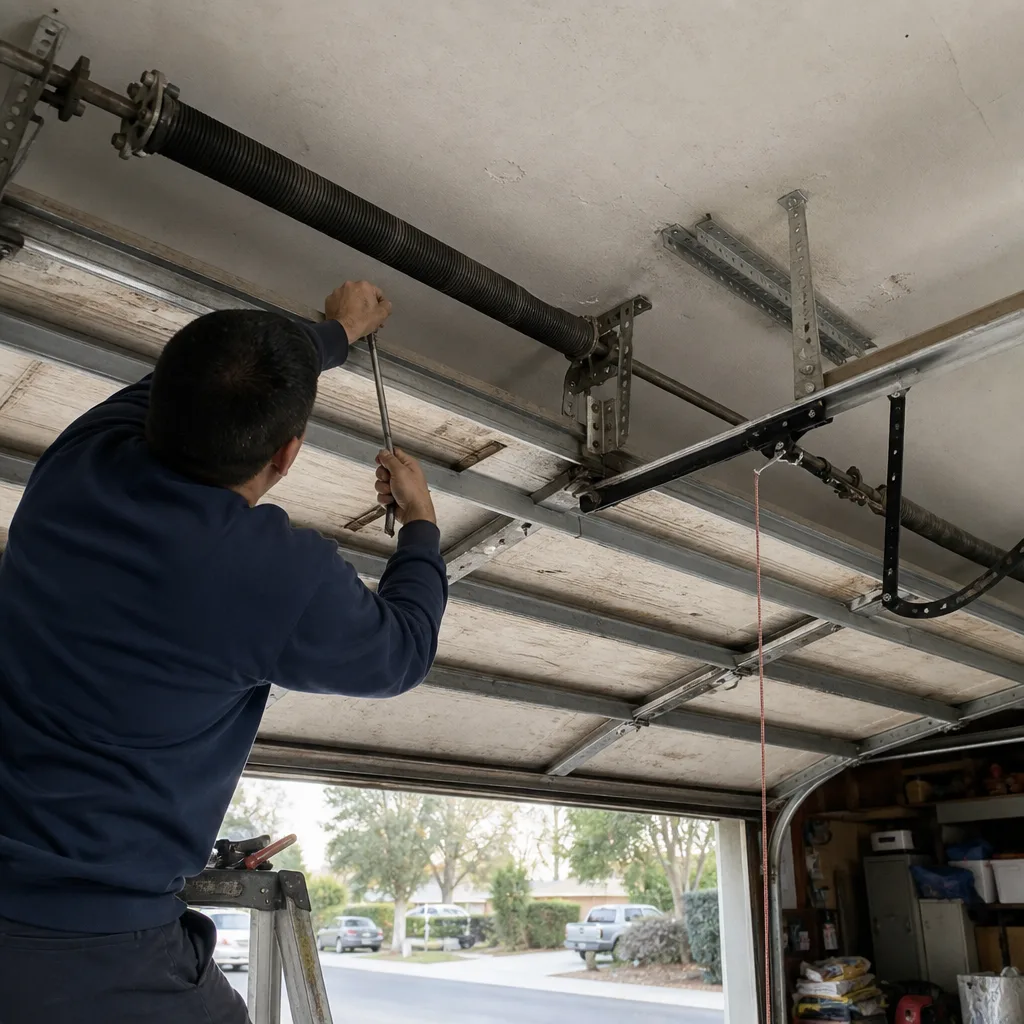
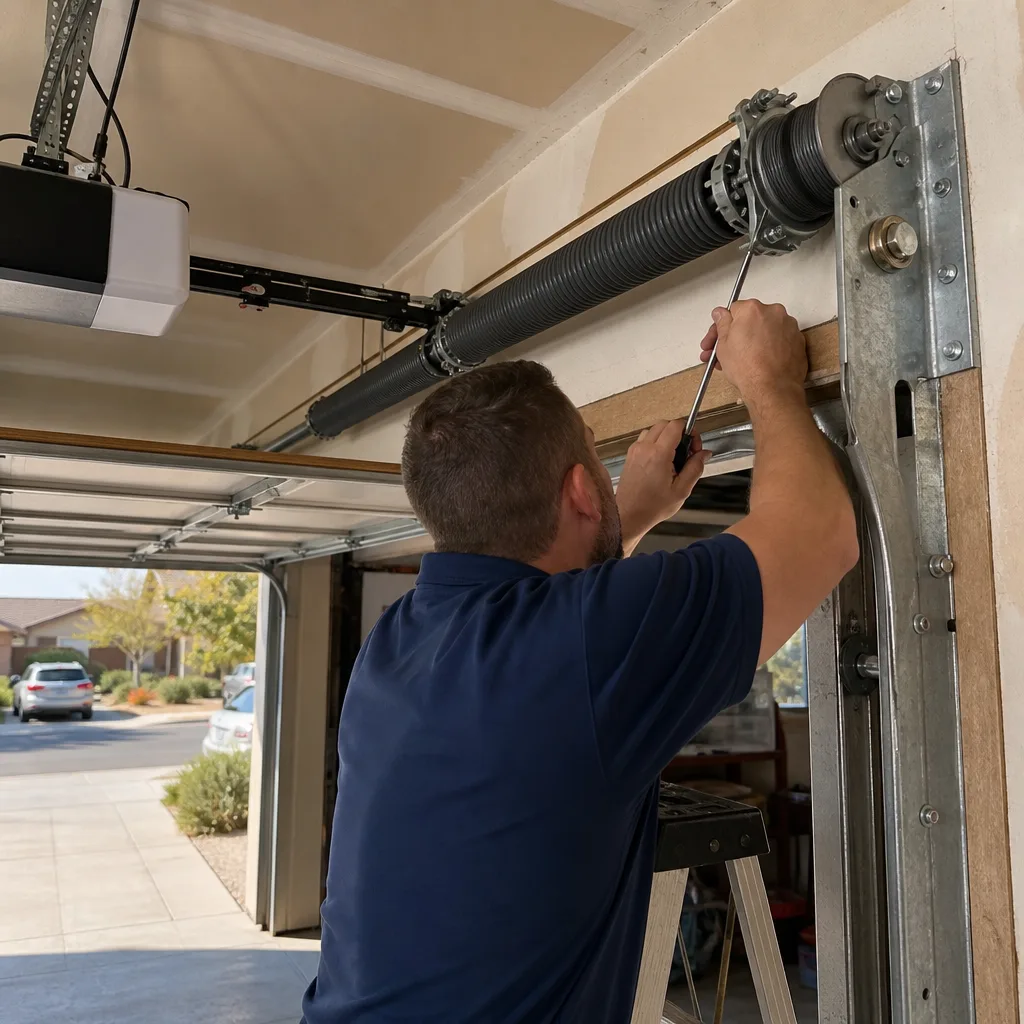
- Look up at the spring assembly. You don’t need to touch it. A broken torsion spring is visible as a two-inch gap in the coil, or as a spring that appears stretched and separated. If you see this, do not use the door.
- Watch one complete cycle. Open and close the door while standing to the side, never underneath. The door should move smoothly, at consistent speed, without hesitation or jerking. Any catch, bounce, or slowdown is a signal.
This inspection takes less time than reading about it. We recommend doing it seasonally - see our Seasonal Garage Door Care for Santee guide - before the summer heat and winter temperature swings that stress Santee garage doors most heavily.
Why a Slow-Closing Door Is a Safety Sensor Issue Until Proven Otherwise
Since 1993, federal law has required all automatic garage door openers to include photoelectric safety sensors. These small boxes sit four to six inches off the floor on either side of the door, sending an invisible beam across the opening. If anything breaks that beam while the door is closing, the door must reverse.
When sensors malfunction, the opener’s default behavior is to treat it as an obstruction. The door closes a few inches, hesitates, then reverses. Or it closes slowly, stuttering down in small increments. Many homeowners assume the opener is failing or the door is too heavy. In our experience across Santee, from Sky Ranch to Cuyamaca Street, the actual cause is sensor misalignment or interference roughly 80% of the time.
How to Safely Test Your Sensors
- With the door fully open, block the sensor beam with a solid object like a cardboard box. Press the close button. The door should not move, or should reverse immediately if already moving.
- Remove the obstruction. Clean both sensor lenses with a dry cloth. Santee’s dust and occasional Santa Ana winds coat these lenses with fine grit that scatters the beam.
- Check that both sensors show a steady indicator light. Typically one glows steadily and the other flickers when misaligned. Loosen the wing nut, adjust until both lights are steady, then retighten.
- Look for physical obstructions. Stored items, garden tools, or even a spider web can break the beam. Sunlight streaming directly into a sensor at certain angles can also blind it, particularly on west-facing garages in Santee’s afternoon heat.
If the door still behaves erratically after these steps, the sensor wiring may be damaged or the logic board in the opener may be failing. At that point, professional diagnosis is warranted. We carry replacement sensors for all major brands including LiftMaster, Chamberlain, and Genie on our trucks, and most sensor replacements in Santee are completed in a single visit.
The Overnight Sag Test: Checking Spring Health Without Tools
Torsion springs do not fail suddenly without warning. They weaken gradually, losing tension in small increments until they can no longer balance the door. The overnight sag test catches this decline before it becomes a breakdown.
Here’s how to perform it safely:
- Close the door completely.
- Pull the red emergency release cord. This disconnects the door from the opener. The door is now in manual mode.
- Lift the door to the halfway open position and release it gently.
- Observe what happens.
A door with healthy springs will stay at the halfway position, or drift only an inch or two in either direction. This means the springs are properly balanced for the door’s weight.
A door that drifts downward more than six inches has weak or fatigued springs. The springs can no longer hold the door’s weight. A door that shoots upward rapidly has springs that are too strong, which is less common but still a problem that strains the opener and hardware.
Perform this test monthly. In Santee, where many homeowners use their garage door as the primary home entrance and cycle it four to six times daily, springs typically last seven to nine years. Homes near the San Diego River, where morning humidity is slightly higher, may see slightly shorter spring life due to minor corrosion at the spring ends.
Never attempt to adjust or replace torsion springs yourself. The spring is under enough torque to cause severe injury or death if handled improperly. This is not a DIY project. If your door fails the sag test, call a professional.
How to Categorize Urgency: This Week, This Weekend, or Stop Using It Now
Not every warning sign demands an emergency call. Some issues can wait for a scheduled appointment. Others mean the door should not be operated again until repaired. Here’s how we categorize them after 42 years of responding to Santee homes.
Schedule Within the Week
- Squeaking or minor grinding that responds to lubrication
- Slight slowing of door travel, opener still sounds normal
- Weatherstrip deterioration or minor air gaps
- Remote control intermittent failure (likely battery or interference)
- Cosmetic panel damage that doesn’t affect operation
These are maintenance and convenience issues. They won’t strand you or damage other components immediately.
Schedule Within 48 Hours
- Door fails the overnight sag test but still opens and closes
- Single loud pop with continued operation (possible two-spring system with one spring broken)
- Visible cable fraying without slack
- Opener straining or overheating smell
- Door reversing intermittently, sensors adjusted but problem persists
These conditions will worsen. The door may still function, but continued operation risks cascading damage to the opener, cables, or panels.
Stop Using the Door Immediately
- Visible gap in torsion spring coil
- Slack or detached cable on either side
- Door comes off its track or roller jumps out
- Door falls rapidly when released manually
- Broken bottom bracket or loose hardware at cable attachment point
- Any structural damage to door that could allow it to collapse
These are genuine safety hazards. The door can fall without warning, causing injury or property damage. Disengage the opener with the emergency release, lock the door manually if possible, and call for service.
In Santee’s summer heat, a garage with a disabled door can reach 110 degrees or more. If you must stop using the door, consider whether vehicles or temperature-sensitive items need to be moved. We prioritize same-day response for safety-category issues, and our trucks carry the parts to complete most repairs in one visit.
How Santee’s Climate Wears on Garage Doors Differently
Santee sits in a transitional zone between coastal San Diego’s mild temperatures and the inland empire’s extremes. This creates specific wear patterns that homeowners in La Jolla or Del Mar don’t experience.
Summer heat in Santee regularly reaches the mid-90s, and garage interiors can exceed 110 degrees. At these temperatures, nylon rollers soften slightly, opener drive gears wear faster, and lubricants thin out and migrate away from bearing surfaces. The thermal expansion of steel tracks is also significant - a 16-foot wide door assembly can expand nearly an eighth of an inch between a cool morning and hot afternoon, stressing hardware that was torqued at moderate temperature.
Winter brings the opposite problem. Occasional frost mornings contract metal components, and the temperature swing from 35 degrees at 6 AM to 65 degrees by noon creates rapid cycling. Springs are particularly vulnerable to this thermal fatigue. We’ve documented higher spring failure rates in January and February across our Santee service area than in any other two-month period.
The Santa Ana wind events, typically in fall and early winter, drive fine dust and debris into track systems and sensor lenses. Homes in the hills above Santee, near Fanita Ranch and the eastern boundaries, see more of this than valley-floor properties. After a Santa Ana event, we always recommend a quick track cleaning and sensor check.
Finally, Santee’s occasional heavy rainstorms, though brief, can flood low-lying garages and damage bottom sections, weatherstrip, and electronic components. If your garage has ever taken water, inspect the bottom panel for swelling or delamination, particularly on wood-composite doors from brands like Amarr or Wayne Dalton.
Opener Warning Signs That Mimic Door Problems
Sometimes the door is fine and the opener is the actual source of trouble. Distinguishing between them saves unnecessary spring or cable replacement.
An opener that runs but the door doesn’t move usually means the carriage has disconnected from the drive chain or belt, or the emergency release has been pulled. Check the red handle first.
An opener that starts, stops, and reverses immediately often indicates a force setting that’s too sensitive. Modern openers have electronic force limits that drift over time. In Santee’s temperature swings, these settings can shift seasonally. However, if adjusting the force doesn’t solve it, the door may genuinely be binding or the springs may be weak.
A grinding sound from the opener head, accompanied by a door that moves slowly or not at all, typically means the main drive gear is stripped. This is a common failure on openers more than ten years old. The gear is replaceable on many models, but if the opener is approaching fifteen years, full replacement may be more economical. We stock drive gears and complete openers for LiftMaster, Chamberlain, Genie, and Craftsman systems, and can advise on repair versus replacement based on the specific unit.
Intermittent remote failure that affects only one remote suggests a failing remote or weak battery. Failure of all remotes and the wall button points to a receiver or logic board issue. Before calling for service, unplug the opener for thirty seconds to reset the logic board. This resolves transient electronic glitches more often than you’d expect.
If your opener is more than fifteen years old and showing any of these symptoms, consider that modern openers offer significant improvements in safety, security, and efficiency. Battery backup is now standard on many models, which matters during San Diego County’s occasional power outages. MyQ and similar smartphone connectivity let you verify the door is closed when you’re away. Garage Door Opener in Santee covers current options and what makes sense for different home configurations.
Common Mistakes to Avoid
- Ignoring a change in sound because the door still works. A new squeak or grind is the door’s only way to ask for help. Waiting until it fails completely turns a $200 roller replacement into a $600 repair with damaged panels and a stripped opener gear.
- Applying WD-40 to rollers, tracks, or springs. WD-40 is a solvent and water displacer, not a lubricant. It attracts dust and dries sticky, making the problem worse. Use a silicone-based garage door lubricant or white lithium grease on metal-to-metal contact points only.
- Attempting to adjust or replace torsion springs after watching an online video. The energy stored in a wound torsion spring is comparable to a loaded firearm. Every year, homeowners suffer serious injuries from DIY spring work. This is not about skill or courage. It’s about specialized tools and training that cannot be acquired from a ten-minute video.
- Assuming a slow door means the opener is failing and replacing it unnecessarily. We’ve arrived at Santee homes where a new opener was installed on a door with broken springs. The new opener strained and failed within months. Always verify spring balance before blaming the opener.
- Blocking safety sensors to force the door to close. This is alarmingly common. Sensors are not an annoyance to defeat. They prevent the door from closing on children, pets, and vehicles. If sensors are misaligned, align them. If they’re faulty, replace them. Never bypass them.
- Neglecting seasonal maintenance because “it’s just a garage door.” In Santee’s climate, a seasonal tune-up pays for itself in extended component life. Our $89 Seasonal Tune-Up includes spring tension check, hardware torque verification, lubrication, sensor alignment, and safety reversal test. Most homeowners who schedule it annually avoid emergency calls entirely.
- Choosing the lowest bid without verifying what’s included. A “spring replacement” quote that doesn’t specify whether both springs are replaced, whether cables are inspected, whether rollers are included, and what warranty applies is not a real quote. It’s a hook. We state every component and our 90-Day Done Right Promise in writing before any work begins, so there are no surprises on the bill.
When to Call a Professional
Call when you cannot confidently categorize the problem using the urgency framework above. Call when the problem involves springs, cables, or anything under tension. Call when the door has come off its track, when the opener is smoking or sparking, or when you simply want a trained set of eyes to tell you what’s actually wrong rather than what might be.
We answer our phones with a live person, 24 hours a day, including nights, weekends, and holidays. No phone trees, no voicemail, no after-hours answering service. Our technicians are background-checked, uniformed, and trained as journeymen under our K.E.Y.S. values code: Krafted right, Every time, Your home first, Standing behind it. Visit our blog for more guides & resources. They arrive with springs, cables, rollers, openers, and parts for all major brands already on the truck, so most repairs are completed in a single visit.
Garage Door Repair in Santee is our core service, and we offer free estimates with upfront pricing stated before any work begins. For immediate assessment, call (619) 762-3668.
Frequently Asked Questions
Most common repairs in Santee fall between $180 and $450, with spring replacement typically at the higher end of that range due to the safety procedures and specialized tools required. We provide an exact written quote before any work begins, and our $50 Off Any Repair Over $250 applies automatically. Call (619) 762-3668 for a free estimate.
A broken torsion spring cannot be repaired. Once the metal has separated, the spring is scrap. Some companies offer “spring repair” that is actually just readjusting a still-intact spring, but if the spring is cracked, separated, or has lost significant tension, replacement is the only safe and lasting solution. We replace both springs on dual-spring systems even if only one has failed, because matched springs ensure even wear and balanced operation.
Standard torsion springs are rated for 10,000 cycles, which translates to roughly seven to nine years for a typical Santee household using the door four to six times daily. The thermal cycling between hot days and cool nights in Santee can accelerate metal fatigue slightly compared to more stable coastal climates. High-cycle springs rated for 20,000 or 30,000 cycles are available and often make sense for homes with heavy use or for homeowners planning to stay long-term.
This usually indicates that the close limit switch needs adjustment, or that the safety sensors are misaligned and detecting a false obstruction at the very end of travel. Less commonly, a warped or damaged bottom panel can trigger the safety reversal system. Check sensor alignment first, then call for professional limit switch adjustment if the problem persists.
Not necessarily. Many door manufacturers, including Clopay and Amarr, offer replacement panels for current and some discontinued models. If the door is less than fifteen years old and the damage is limited to one or two panels, panel replacement may be cost-effective. If the door is older, has multiple damaged panels, or the insulation or structural integrity is compromised, full replacement may be the better investment. Garage Door Installation in Santee covers options and what to consider.
A thorough inspection covers spring tension and condition, cable wear and attachment integrity, roller condition and lubrication, track alignment and fastening, hinge and hardware torque, opener force settings and safety reversal function, sensor alignment and response, weatherstrip condition, and overall door balance. Our $89 Seasonal Tune-Up includes all of these checks plus necessary adjustments and lubrication, performed by a trained technician who will explain anything that needs attention.
The Bottom Line
Your garage door speaks before it fails. The sounds, the movements, the subtle changes in how it responds - these are not mysteries. They are mechanical signals with specific causes and predictable outcomes. A Santee homeowner who learns this language gains the ability to act before the emergency, to schedule rather than scramble, and to distinguish a $200 maintenance visit from a $1,200 breakdown repair.
The key takeaways: perform the three-minute visual inspection seasonally, run the overnight sag test monthly, never ignore a new sound, and never attempt DIY work on springs or cables. Categorize urgency honestly. When in doubt, have a trained technician assess the door. The cost of an inspection is always less than the cost of a failure.
At Mainspring Garage Door Co., we’ve served Santee and surrounding communities since 1984. We answer the phone with a live person 24/7, state our prices upfront, and stand behind every job with our 90-Day Done Right Promise in writing. If your door is showing warning signs, or if you simply want the confidence of a professional assessment, call (619) 762-3668 for a free estimate.
Written by Carl Dutton, Owner at Mainspring Garage Door Co., serving Santee since 2016.