
Last updated September 10, 2026
Full 25-point door and opener safety check with every visit - springs, cables, rollers, tracks, and your LiftMaster or Chamberlain opener included
You get a price before we start. It does not change when the truck arrives.
 Before
 After
After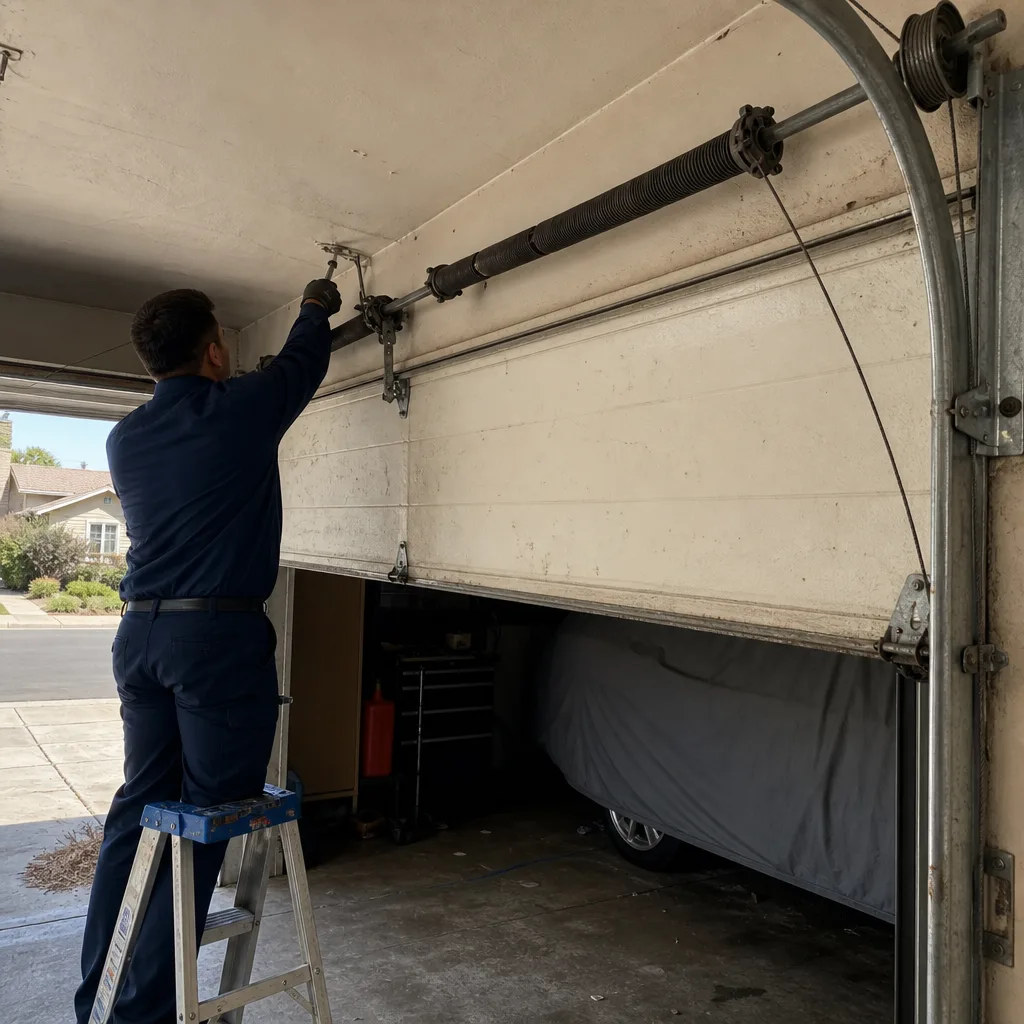 Before
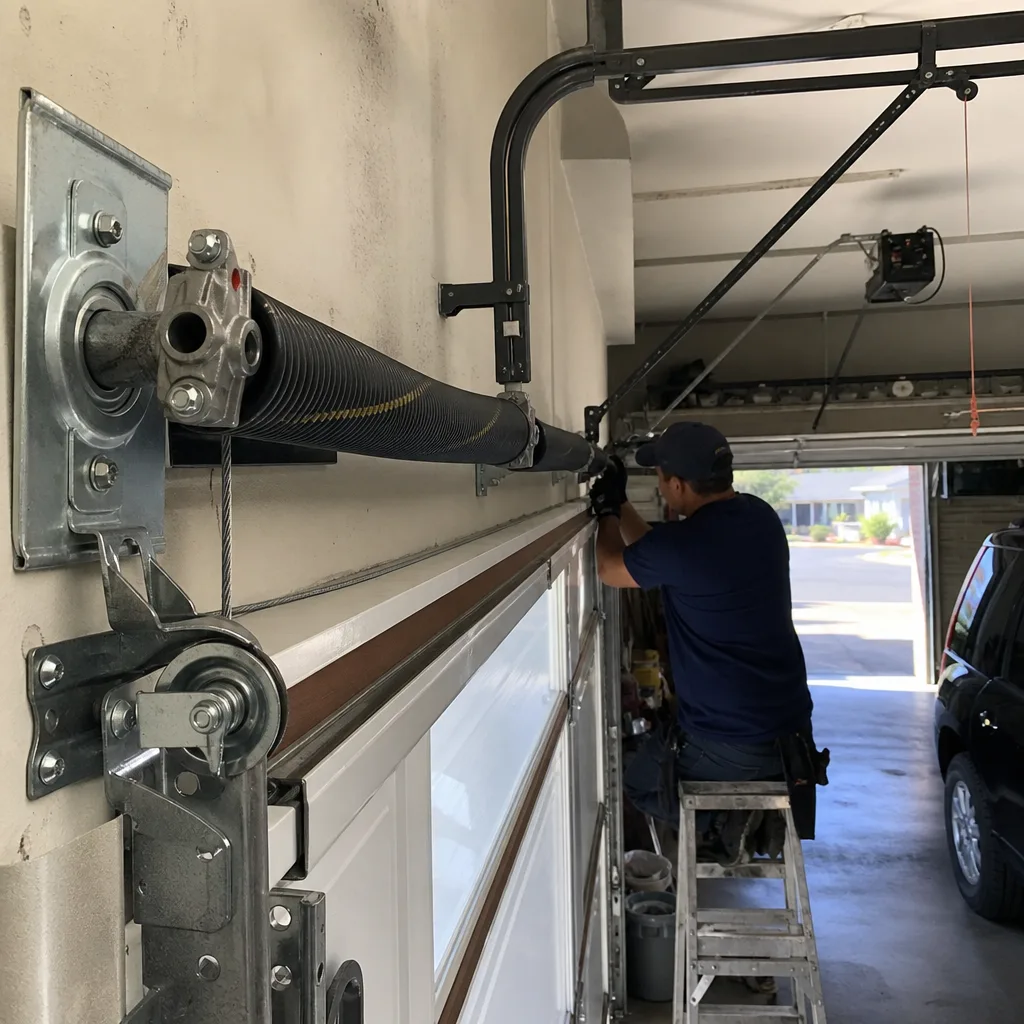 After
After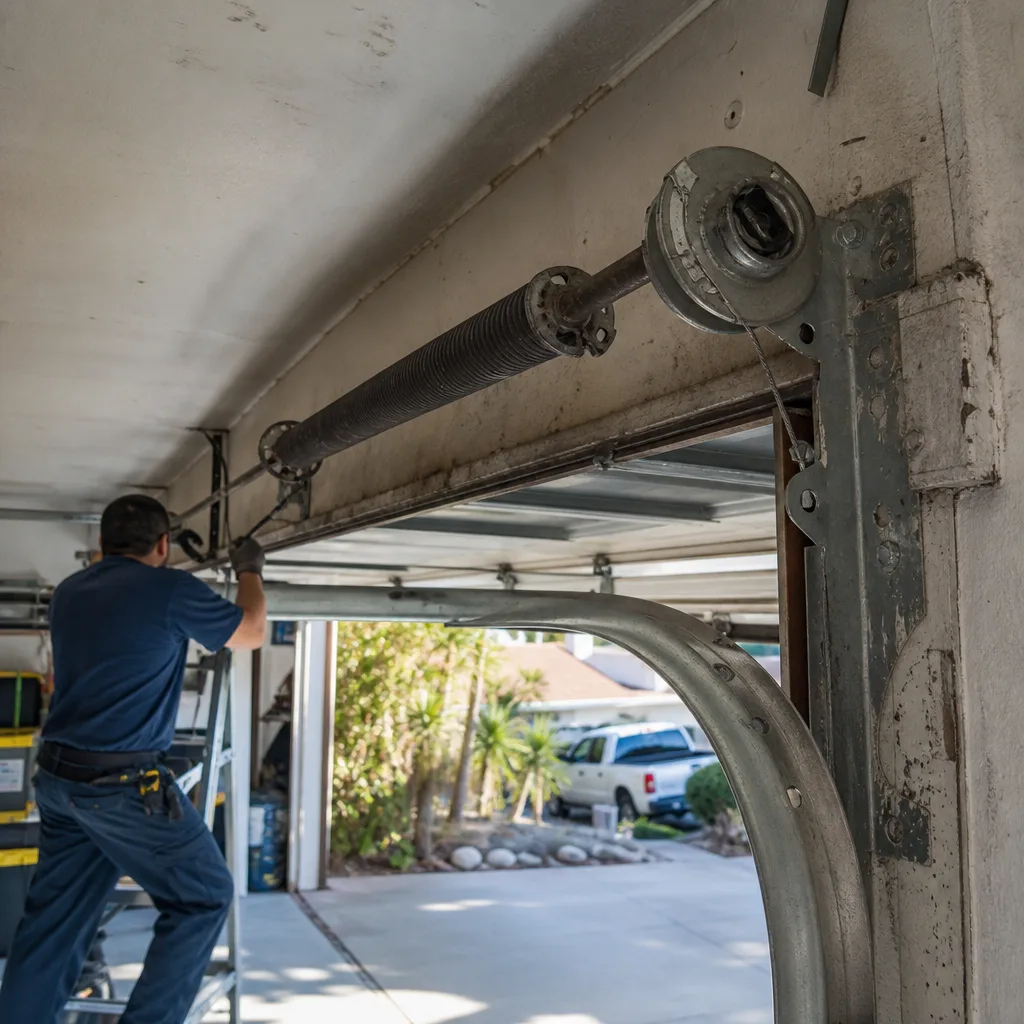 Before
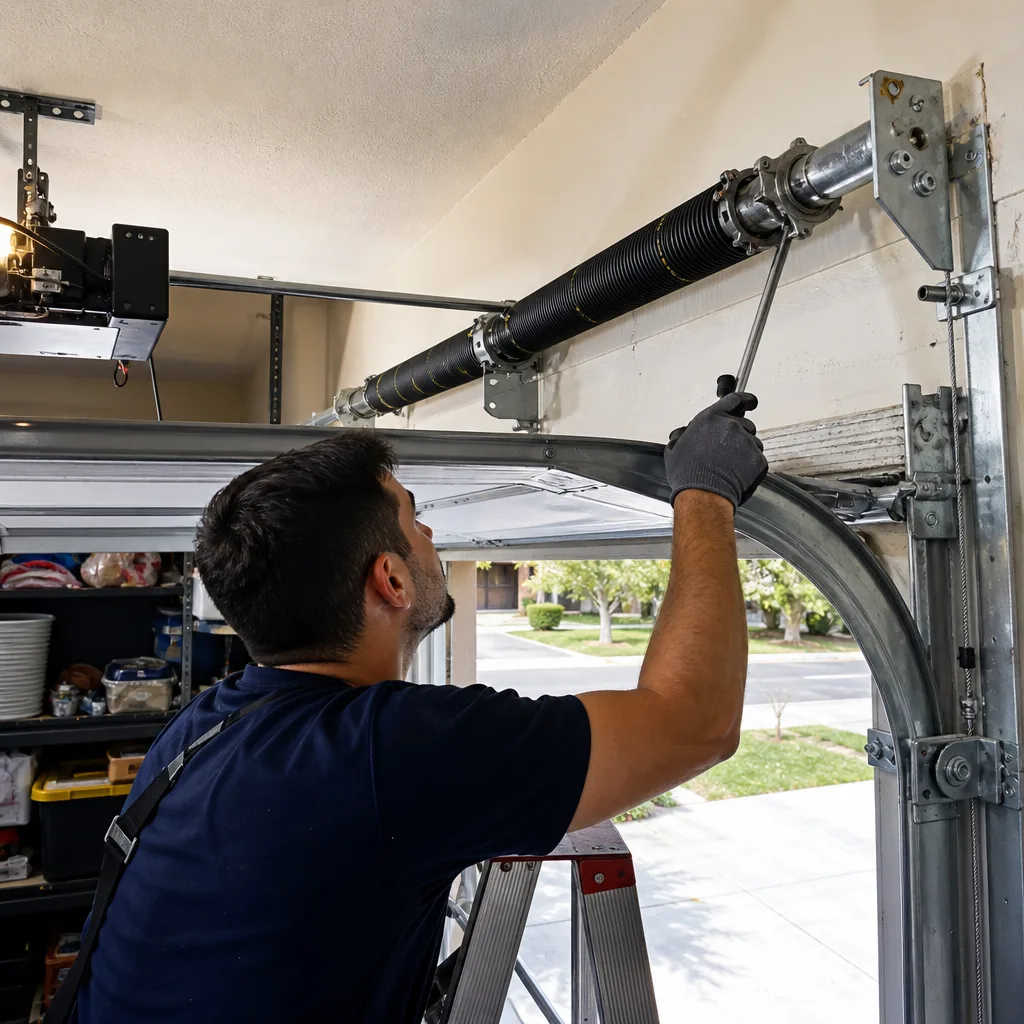 After
AfterHow to Hire a Garage Door Contractor in Santee: A Step-by-Step Guide
California requires a C-61/D28 specialty license for any garage door work over $500, yet most Santee homeowners never ask to see it. In 42 years of serving this trade, we’ve watched fly-by-night operators roll through East County with nothing more than a magnetic sign and a borrowed ladder. The garage door industry has almost no barrier to entry. This guide and our Complete Guide to Garage Door in Santee give you a repeatable interview process to separate real tradespeople from opportunists before anyone touches your door.
Quick Answer
To hire a garage door contractor in Santee, verify their C-61/D28 license on the CSLB website, demand a written itemized quote before work begins, confirm they carry general liability and workers’ compensation insurance, and ask five specific phone-screening questions that expose bait-and-switch pricing. A legitimate contractor answers directly. A sketchy one deflects.
Table of Contents
- Why the C-61/D28 License Matters in California
- How to Verify a License in 90 Seconds
- Five Phone Questions That Filter Out Bad Actors
- What a Written Quote Must Include to Protect You
- Red Flags Specific to Garage Door Bids
- How to Read a Warranty Clause (And What It Actually Covers)
- Insurance, Bonds, and Why Verbal Proof Is Worthless
- Santee-Specific Considerations: Climate, Codes, and Neighborhoods
Why the C-61/D28 License Matters in California
Garage door work sits in a regulatory gray zone that confuses even experienced homeowners. The C-61 classification covers limited specialty contracting, and the D28 subcategory specifically governs “doors, gates, and activating devices.” Any project exceeding $500 in combined labor and materials requires this license. Operating without it is a misdemeanor under California Business and Professions Code Section 7028.
Here’s what the license actually proves. The contractor passed a trade-specific examination administered by the Contractors State License Board (CSLB). They carry a $25,000 contractor’s bond. Their business name and personnel are on file with the state. If they disappear mid-job or damage your property, you have recourse through a formal regulatory channel.
We’ve encountered unlicensed operators in Santee who argue that “repair work under $500” exempts them. This is technically true but practically meaningless. A spring replacement on a double-wide door with high-cycle torsion hardware routinely exceeds $500. More importantly, the exemption becomes a loophole. An unlicensed contractor who underbids the initial call has every incentive to “discover” additional problems once they’re in your driveway.
The license also matters for your homeowner’s insurance. If an unlicensed worker is injured on your property and lacks workers’ compensation coverage, your policy may deny the claim. We’ve seen this scenario twice in our years serving Santee and Lakeside. The homeowner saved $80 on the repair and absorbed $40,000 in medical liability.
Some legitimate handymen carry a B-General license, which legally permits garage door work. This is acceptable but not equivalent. The B license holder passed a general building exam, not a door-specific one. For complex torsion spring systems or custom wood doors common in Santee’s older neighborhoods, the D28 specialization signals deeper expertise.
How to Verify a License in 90 Seconds
The CSLB website runs a public license check that requires no account, no fee, and no personal information. Here is the exact process:
- Navigate to cslb.ca.gov and click “Check License.”
- Enter the contractor’s license number or business name.
- Review the “License Status” field. It must read “Active,” not “Suspended,” “Expired,” or “Cancelled.”
- Click the “Workers’ Compensation” tab. Verify coverage is current or that the contractor is exempt with a valid certificate.
- Scroll to “Bond.” Confirm the $25,000 bond is in force.
- Check “License Classification.” You want C-61/D28 or B-General. Anything else is insufficient for garage door work over $500.
Do this while the contractor is still on the phone. A legitimate operator expects it. We’ve had Santee customers read our license number back to us during the initial call, and we respect the diligence. Any contractor who bristles, rushes you, or claims verification is “unnecessary” has already told you everything about their operation.
Take a screenshot of the results. Email it to yourself with the contractor’s name and date. If a dispute arises later, this timestamped record becomes evidence. The CSLB also maintains a disciplinary history searchable by license number. A single complaint may be a disgruntled customer. Three or more for similar issues is a pattern worth heeding.
Five Phone Questions That Filter Out Bad Actors
These questions work because they target the specific vulnerabilities of garage door scams. Ask them in this order. The answers that disqualify a contractor immediately are noted.
1. “What is your CSLB license number, and what classification do you hold?”
Disqualifying answer: “We work under our partner’s license,” “We’re licensed for handyman work,” or refusal to provide a number. Some operators rent another company’s license illegally. Others hold only a C-36 Plumbing or C-10 Electrical license, neither of which covers door work. Get the number and verify it before scheduling.
2. “Can you give me a flat price for a standard torsion spring replacement, or do you need to see it first?”
Disqualifying answer: “We have to assess on-site” for a routine spring swap. A journeyman technician knows the three variables: door weight, spring cycle rating, and single versus double spring. Over the phone, we can quote a precise range for 90% of Santee homes. The “assess on-site” model is the classic setup for a bait-and-switch. The technician arrives, declares your springs “commercial-grade” or “obsolete,” and the price doubles.
3. “Do you stock springs and openers on your trucks, or do you order parts after diagnosis?”
Disqualifying answer: “We come out first, then order what you need.” This means two trips, two dispatch fees, and your door stuck open for days. In Santee’s variable climate, an open garage exposes your home to dust, heat, and security risk. Our trucks carry springs for standard 7-foot and 8-foot doors, cable sets, rollers, and LiftMaster and Chamberlain openers. Most repairs finish in a single visit.
4. “What does your warranty cover, and is it in writing?”
Disqualifying answer: “We guarantee our work” with no specifics, or a verbal promise that “the manufacturer covers defects.” The warranty is where many contractors hide their escape hatch. We’ll dissect this further in the warranty section, but on the phone, you want to hear: specific duration, parts and labor both included, no deductible, and written on the invoice.
5. “Who answers your phone after 6 p.m. and on weekends?”
Disqualifying answer: “Leave a message and we’ll call back,” or an answering service that cannot dispatch. Garage doors fail when they fail. A stuck door on Saturday evening with your car trapped inside is not a Monday problem. At Mainspring, a live person answers every call, 24/7, including holidays. We’ve taken calls at 11 p.m. from Santee homeowners whose spring snapped as they returned from a Padres game. The person who answers should be able to schedule service, not just take a message.
What a Written Quote Must Include to Protect You
California law does not require a written contract for jobs under $500, but a written quote is your only enforceable protection against invoice shock. Here’s what belongs on the document, and why each element matters.
Itemized parts with quantities and unit prices. “Spring replacement: $289” is not itemized. “2 x 0.250 x 2″ x 32″ high-cycle torsion springs @ $89 each; 2 x cable sets @ $34 each; labor @ $95/hr x 1.5 hrs” is itemized. Unlabeled parts are a common tactic. We’ve seen Santee customers charged $180 for a “heavy-duty roller set” that was standard 2-inch nylon worth $22. If the quote lacks part numbers or descriptions, the contractor can substitute whatever they have in the van.
Labor rate and estimated hours. A flat-rate quote is acceptable if the rate is stated. Time-and-materials quotes must show the hourly rate. Be wary of “diagnostic fees” that apply only if you decline the repair. This is a pressure tactic. The diagnostic work is part of the repair. We do not charge separately to tell you what’s wrong.
Total price with tax calculation. The final number must match the sum of the line items. Discrepancies suggest hidden fees or math errors that won’t favor you.
Payment terms. Never pay more than 10% or $1,000 upfront, whichever is less, per California law. For garage door repairs, reputable contractors in Santee typically collect on completion. We do not take deposits for standard repairs. For new door installations, a modest deposit to order custom materials is standard, but it should never exceed the legal limit.
Start date and estimated completion. Vague scheduling (“we’ll be out sometime next week”) is a warning sign. Specificity matters.
Signature lines for both parties and the date. A quote without signatures is a proposal, not a contract. Both parties must sign for mutual obligation.
Verbal estimates are legally unenforceable in California. A contractor who says “$250, give or take” and then invoices $487 has broken no law if nothing was written. The written quote is your evidence in small claims court, in a CSLB complaint, or in a credit card dispute. We provide every Santee customer a printed, signed quote before any tool touches the door. The price we state is the price on the bill. No surprises.
Red Flags Specific to Garage Door Bids
The garage door trade attracts a particular breed of opportunist because the work looks simple and the parts are unfamiliar to most homeowners. These red flags appear repeatedly in Santee complaints filed with the CSLB and the Better Business Bureau.
The “assess on-site and then add” pricing model. The technician arrives, spends ten minutes inspecting, and declares the job “more complicated than described.” The price jumps 40-100%. This is not diagnosis. This is a scripted upsell. A competent contractor identifies the likely scope from your description and quotes a range with a ceiling. Our phone quotes include a maximum: “Between $240 and $290, never more than $290.” If we encounter an anomaly, we stop and explain before proceeding.
Unlabeled or generic parts presented as premium. “Heavy-duty,” “commercial-grade,” and “professional series” are meaningless without brand names and specifications. Insist on manufacturer labels. A spring should show the wire size, inside diameter, and length. An opener should show the brand and model number. We install LiftMaster, Chamberlain, Craftsman, and Raynor openers with factory packaging intact. The homeowner sees exactly what they’re paying for.
Same-day pressure tactics. “I can do it right now for $150 off, but only if you decide today.” This exploits your inconvenience, not your best interest. The discount is fictional, the regular price inflated. A legitimate contractor in Santee has enough work without manufacturing urgency. Our standing offers, $50 off repairs over $250 and the $89 Seasonal Garage Door Care for Santee: Year-Round Homeowner’s Guide, are available any day you call. They do not expire because you need time to think.
Refusal to put the warranty in writing. A verbal “lifetime warranty” sounds generous. It is worthless. Lifetime of what? The part? The labor? Your ownership of the home? Written warranties define the term, the coverage, and the process for claims. Our 90-Day Done Right Promise states: if the work is not right, we return at no charge. No paperwork to file, no dispute, no argument. It is printed on every invoice.
Demanding cash for a “discount.” Cash payments leave no paper trail. They also suggest tax evasion, which correlates with other corner-cutting. We accept checks, cards, and cash with a printed receipt. Every transaction is documented.
How to Read a Warranty Clause (And What It Actually Covers)
Warranty language is where contractors hide their exit. Here is how to parse the common structures.
“90-day parts and labor.” This covers both the component and the work to install it for ninety days. If the spring breaks on day 45, the contractor replaces it free. This is the standard we offer. It is also the minimum a homeowner should accept.
“One-year manufacturer warranty on parts.” This covers only the component. If the opener motor fails, the manufacturer sends a replacement part. The contractor charges you labor to install it. On a $400 opener, the labor to swap the motor can run $200-250. You saved nothing. Always ask: “Does the warranty include labor for replacement?”
“Lifetime warranty on springs.” Read the definition of “lifetime.” Often it means the lifetime of the original homeowner at that address. Sell the house, and the warranty voids. Sometimes it means the “reasonable lifetime of the part,” which the contractor defines. We’ve seen “lifetime” springs fail in 18 months and heard the contractor claim “normal wear.” A true high-cycle spring rated for 25,000 cycles should last 12-15 years in typical Santee use. The warranty should match that expectation.
“Prorated after one year.” You pay a percentage of replacement cost based on age. By year three, you may pay 60% of a new part plus full labor. This is not a warranty. It is a maintenance plan with poor terms.
Our 90-Day Done Right Promise is deliberately simple. We do not prorate, we do not transfer conditions, we do not require original receipts. If we installed it and it is not right, we make it right. The promise is in writing on every job. Carl Dutton put it there when he took over daily operations, and it has not changed.
Insurance, Bonds, and Why Verbal Proof Is Worthless
Every legitimate garage door contractor in Santee carries three financial protections. Request certificates for all three. Do not accept verbal confirmation.
General liability insurance. This covers property damage and bodily injury to third parties. If a technician drops a door on your car or a spring snaps and damages your garage interior, this policy responds. Minimum respectable coverage is $1 million per occurrence. Ask for a certificate of insurance (COI) naming you as the certificate holder for the project date. This takes the contractor’s agent 48 hours to produce. Any delay is suspect.
Workers’ compensation insurance. California requires this for any business with employees. It covers injuries to workers on your property. If the contractor has no employees, they may be exempt. Verify the exemption certificate on the CSLB site. An unlicensed operator with no workers’ comp who gets injured on your driveway can sue you directly. This is not theoretical. It happens.
Contractor’s bond. The $25,000 bond required for CSLB licensure protects you against financial loss from defective work or failure to pay subcontractors and suppliers. It does not cover the full value of most jobs, but it provides a recovery path through the CSLB’s disciplinary process.
We provide COIs on request for any opener installation or major repair in Santee. The document comes from our insurance broker, not from a photocopied template. This is standard practice for tradespeople who intend to stay in business.
Santee-Specific Considerations: Climate, Codes, and Neighborhoods
Santee’s geography creates distinct garage door challenges that an out-of-town contractor may miss. Hiring locally means hiring someone who has worked in your specific conditions.
Heat and UV exposure. Santee sits inland enough to escape San Diego’s marine layer most days. Summer temperatures in Mainspring Garage Door Co. home territory routinely hit 95°F, with garage interiors reaching 110°F. Steel doors expand in heat, stressing hardware. Powder-coated finishes degrade faster than in coastal climates. We specify UV-resistant seals and recommend lighter colors for west-facing doors in neighborhoods like Sky Ranch and Carlton Hills.
Dust and Santa Ana winds. The eastern edge of Santee catches dust from the Cleveland National Forest corridor. Fine particulate works into roller bearings and track joints, accelerating wear. In our experience, homes near the 52 corridor and Mast Park need more frequent track cleaning and lubrication than coastal properties. Our $89 seasonal tune-up addresses this specifically.
Neighborhood age and door types. Santee’s housing stock spans five decades. The original 1960s tracts near Mission Gorge Road often have low-headroom track configurations that constrain replacement options. 1980s and 1990s developments in Rio Vista and Santee Lakes feature raised-panel steel doors that are straightforward to service but may have outdated single-panel lift mechanisms. Newer construction in Walker Reserve uses heavier insulated doors that require precise spring calibration. A contractor who has not worked in these specific neighborhoods may misdiagnose or order wrong parts.
Local permit requirements. The City of Santee requires permits for new garage door installations that alter the opening size or structural elements. Simple replacement-in-kind typically does not require permitting, but adding windows, changing from single to double door, or modifying the header does. An unlicensed contractor will not pull permits. A licensed contractor who cuts corners may skip them. Ask directly: “Will you obtain the necessary permits, and is that cost in the quote?”
HOA considerations. Several Santee neighborhoods, including portions of Carlton Oaks and the gated communities off Fanita Drive, have architectural review committees with specific color and style requirements. A local contractor knows which HOAs require pre-approval and which accept standard neutral palettes. We’ve delayed jobs because a homeowner’s HOA rejected a door color that looked fine to the contractor but violated the CC&Rs. Local knowledge prevents this.
Common Mistakes to Avoid
- Hiring based on the lowest bid alone. In Santee’s competitive market, the low bid often excludes necessary parts, uses recycled springs, or carries no warranty. The $180 spring replacement that fails in six months costs more than the $260 repair that lasts a decade.
- Accepting a verbal estimate. California law favors written agreements. Without one, you have no recourse for invoice inflation, substituted parts, or incomplete work.
- Neglecting to verify the license at the CSLB site. A contractor who shows you a photocopied license card may have borrowed it, expired it, or had it suspended. The website is the only authoritative source.
- Ignoring workers’ compensation status. An injured worker without coverage becomes your financial liability. The CSLB verification takes 90 seconds and saves potentially tens of thousands.
- Signing a blank or incomplete quote. Never sign a document with blank spaces for “additional work as needed.” This is an open authorization for unlimited charges.
- Failing to ask about parts brands and specifications. Generic “heavy-duty” springs fail faster than named-brand high-cycle springs with published cycle ratings. Insist on specifics.
- Choosing a contractor who cannot service your opener brand. If you have a Genie, Raynor, or Craftsman system, confirm factory familiarity. Installing a new LiftMaster on a misaligned Genie rail causes premature failure.
When to Call a Professional
Some garage door symptoms demand immediate professional attention. A door that reverses unpredictably, a spring with visible gaps in the coils, a cable that has unspooled from the drum, or an opener that strains without lifting are all safety hazards. Torsion springs store lethal energy. Cables under tension can cause serious injury if handled improperly.
We do not recommend DIY diagnosis of spring or cable issues. The visual inspection, what to check for, is: rust-colored dust near the spring ends (indicates fatigue), a door that feels heavier than usual on manual lift, or uneven hanging that suggests a failed cable. If you observe these, stop using the door and call a trained technician.
Mainspring Garage Door Co. offers free estimates in Santee. A technician arrives, assesses the door, and provides a written quote with no obligation. Call (619) 762-3668 to schedule. We answer live, 24/7.
Frequently Asked Questions
Standard repairs in Santee range from $180 for a cable replacement to $340 for a dual torsion spring swap, with opener repairs typically between $150 and $280 depending on the component. We provide exact quotes after a brief phone description or free on-site assessment. Call (619) 762-3668 for a specific estimate, estimates are free.
A handyman can legally perform garage door work under $500 total, but cannot legally exceed that threshold without a C-61/D28 or B-General license. For spring replacements, opener installations, or structural repairs, the specialized license matters for your protection. We recommend verifying any contractor’s classification regardless of project size.
Request a certificate of insurance naming you as certificate holder, then verify the policy directly with the insurance company using the policy number. Do not accept a photocopy or verbal assurance. The CSLB website also shows workers’ compensation status. This verification takes five minutes and protects you from liability.
A written quote must include itemized parts with specifications, labor rate and estimated hours, total price with tax, payment terms, start and completion dates, warranty terms, and signature lines for both parties. Without these elements, the document is not an enforceable contract under California law.
Reputable contractors in Santee offer 90 days to one year on parts and labor combined. Manufacturer-only warranties that exclude labor leave you paying for installation twice. Our 90-Day Done Right Promise covers parts and labor with no deductible, no paperwork, and no expiration of the commitment to make it right.
The City of Santee requires permits for new installations that alter the opening size, structural header, or exterior appearance in a significant way. Replacement-in-kind typically does not require permitting. A licensed contractor knows the distinction and should include permit costs in the quote when applicable. Ask directly.
The Bottom Line
Hiring a garage door contractor in Santee comes down to four verifiable facts: an active C-61/D28 license checked on the CSLB website, a written itemized quote signed before work begins, current insurance certificates you can confirm independently, and warranty terms that specify parts, labor, and duration in writing. The contractors who pass this screen are the ones who intend to be in business when you need them again. The ones who fail it were never planning to stay.
At Mainspring Garage Door Co., we’ve operated on these terms since 1984. Carl Dutton answers the phone or oversees the person who does. Our trucks carry the parts. Our quotes state the flat price before the work starts. And our 90-Day Done Right Promise is printed on every invoice because we intend to honor it.
Call (619) 762-3668 for a free estimate in Santee. A live person will answer, any hour, any day.
Written by Carl Dutton, Owner at Mainspring Garage Door Co., serving Santee since 2016.